

When people think of Korea’s nightlife, many picture the “okiya” (window brothel) districts — but plenty of visitors are unsure where to go, how much it costs, or whether it’s even safe. The local system is complex, and the risk of running into trouble makes it essential to arm yourself with the right information beforehand.
This article breaks down how to enjoy Korean okiya and the typical price ranges. The second half covers Korea’s most famous okiya districts and important precautions, so if you’re feeling nervous about visiting one for the first time, this guide is for you.
Korean adult entertainment — if you want to know about other options, check out the article below.
 【2026】Seoul Adult Entertainment Guide: Types, Prices & Tips
Table of Contents
Korean Okiya: Full Service in a Short Time
Korean okiya are a unique form of adult entertainment where you can enjoy everything up to full service in around 20–30 minutes. The concept is simple: women wait inside small glass-fronted shops under bright lights, and you check out their looks from outside before stepping into the one you like.
 Kenny
Kenny
How It Works
Here’s the typical flow at an okiya:
- Check out the women through the glass from outside
- Enter the shop with the woman you like
- Negotiate the price directly with her
- Move to the play room
- Pay upfront
- Shower or wipe down
- Session begins (20–30 minutes)
- Leave after finishing
At Korean okiya, you can take your time checking out each woman’s face and figure from outside before entering. Inside, around 2–5 women are usually waiting — doing their makeup or scrolling their phones while they wait for customers.
Price negotiation is done directly with the woman, but English often doesn’t get you far, so having a translation app ready is a must. The standard service includes oral service (with condom) and full service, and depending on the shop or the woman, extras like kissing and foreplay may also be available.
How It Differs from Japan’s Tobita Shinchi
Korean okiya are similar to Japan’s Tobita Shinchi, but there are clear differences. The most obvious one is the touts. At Tobita Shinchi, older women known as “yaritebaaba” actively call out to passersby to lure them in — but in Korea, except for places like Miari Texas, the standard approach is for customers to walk in on their own.
The pricing structure is also quite different. Tobita Shinchi has clearly set time-based rates (15, 20, or 30 minutes), whereas in Korea, you negotiate directly with the woman. That means prices vary, and what you end up paying can shift depending on how the negotiation goes.
Typical Price at Korean Okiya: From 75,000 Won (approx. ¥8,000)
Prices at Korean okiya vary by area and shop, but the going rate starts around 75,000 won (approx. ¥8,000). Sessions are on the shorter side at 20–30 minutes, but they include oral service (with condom) and full service — so compared to Japanese adult entertainment, it’s actually pretty good value.
Some shops have proper shower facilities where the woman will wash you down carefully, while others just do a quick wipe. Also worth noting: Japanese customers are often charged a “foreigner surcharge” of around 19,000 won (approx. ¥2,000) on top of the standard price, so keep that in mind.
How to Get to Korean Okiya Districts
Korea’s okiya are mainly scattered across Seoul, Paju City, and Busan, so you’ll need to plan based on your itinerary and preferences. Here’s a breakdown of how to get to each major area.
Kenny
How to Get to Seoul
Seoul is home to the main okiya districts, and the biggest advantage is how easy it is to stop by alongside sightseeing or business. From Incheon International Airport, it’s roughly 1.5 to 2 hours by train.
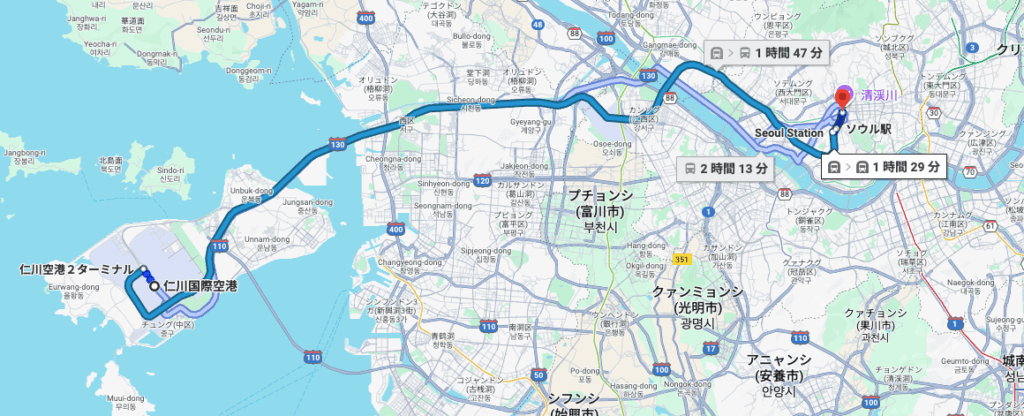
※Route from Incheon International Airport to Seoul.
From Gimpo International Airport, you can arrive in about 45 minutes to an hour.
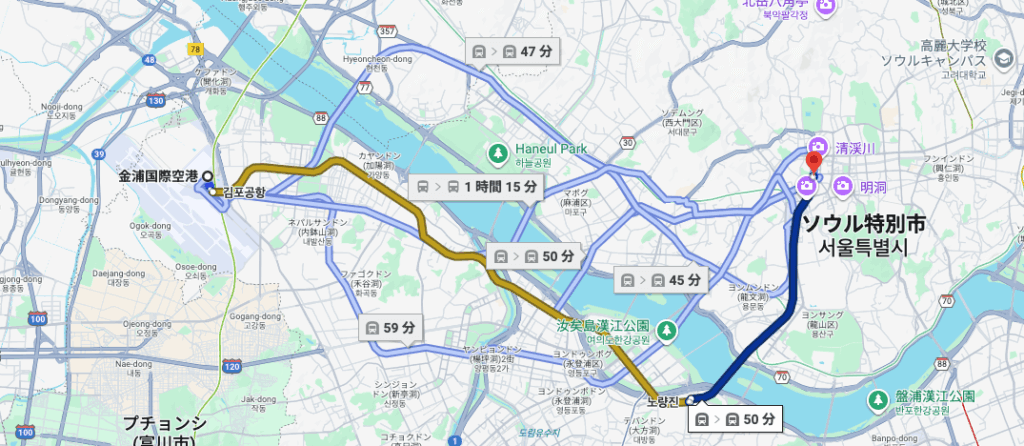
※Route from Gimpo International Airport to Seoul.
Gimpo is closer to the city center and more convenient, but note that direct flights there are limited to Haneda and Kansai airports.
How to Get to Paju City
From Incheon International Airport to Paju City, expect around 1.5 to 2.5 hours by train. Paju is close to the North Korean border and has an okiya district with a uniquely distinct atmosphere.
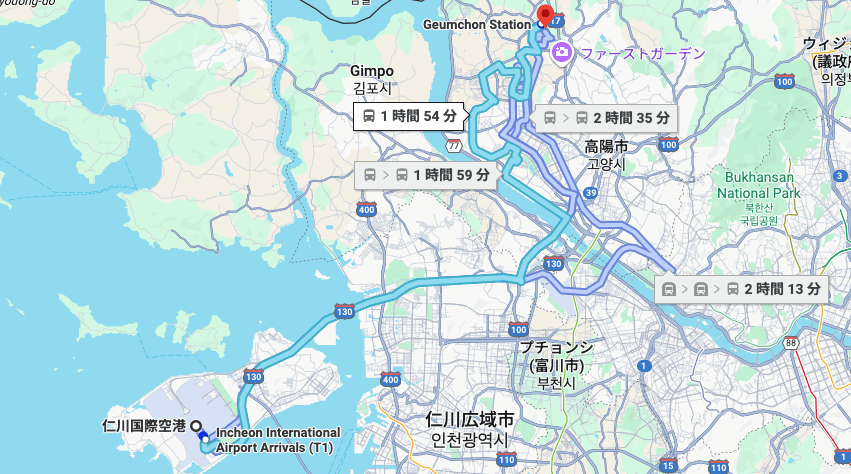
※Route from Incheon International Airport to Paju City.
From Gimpo International Airport to Paju City takes about an hour. Even from central Seoul, it’s around 1.5 hours, so access isn’t exactly convenient.
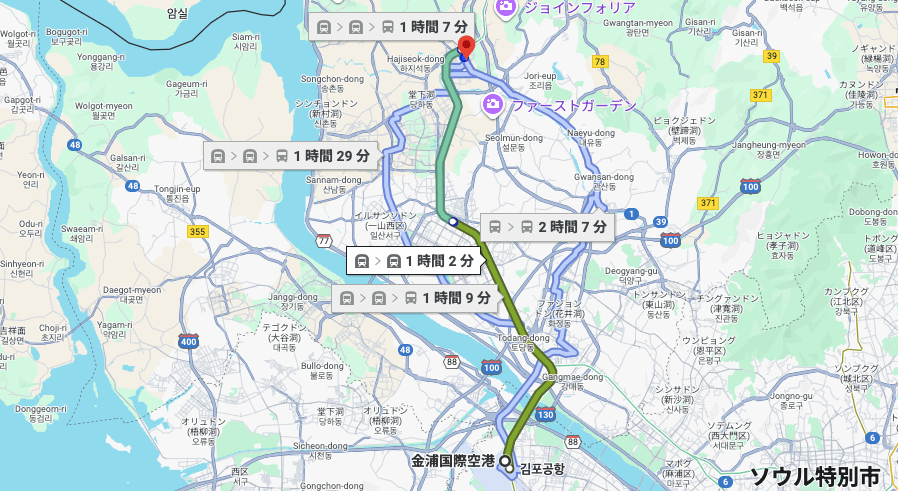
※Route from Gimpo International Airport to Paju City.
The last train runs early, so you’ll need to head back before 10 PM — it’s best to give yourself some extra time in your schedule if you plan to visit.
How to Get to Busan
To get to Busan, the nearest airport is Gimhae International Airport — from there, it’s about an hour by subway or train.
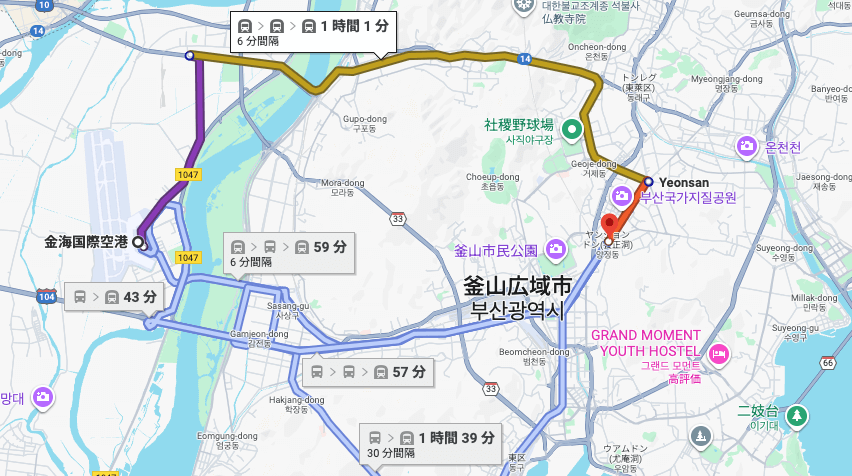
※Route from Gimhae International Airport to Busan.
There are direct flights from multiple airports in Japan including Narita and Kansai, making access extremely easy. With plenty of seafood restaurants and tourist spots, Busan is a great place to combine okiya with a proper trip.
Top 5 Famous Okiya Districts in Korea
Here are five of Korea’s most well-known okiya districts. Each district has its own distinct character, with differences in location, pricing, and services. In recent years, many okiya districts have been shrinking due to urban development and increased crackdowns. Always check for the latest info before you visit.
| District | Miari Okiya (Miari Texas) | Yeongdeungpo Okiya | Cheonho-dong Okiya | Yeongjukol | Wanwol-dong Okiya |
| Area | Seoul | Seoul | Seoul | Paju City | Busan |
| Price | 75,000 won (approx. ¥8,000)~ | 9,400 won (approx. ¥10,000)~ | 75,000–200,000 won (approx. ¥8,000–¥22,000) | 94,000–110,000 won (approx. ¥10,000–¥12,000) | 75,000 won (approx. ¥8,000)~ ※Overnight stay: 230,000 won (approx. ¥25,000)~ |
| Full service | Yes | Yes | Yes | Yes | Yes |
| Age range of women | 30s | 20s–30s | 20s–30s | 20s–30s | 20s–30s |
| Current status (as of September 2025) | Essentially gone | Scaled down | Nearly gone | Scaled down | Nearly gone |
| Features | ・Women wear hanbok (traditional Korean dress) ・Aggressive touts |
・Small scale ・Few touts, easy to navigate |
・One of the “Big Three” okiya districts ・Longer sessions available |
・Once the largest in Korea ・Poor access |
・Overnight stays available ・More comprehensive services |
Miari Okiya (Miari Texas)
Miari Texas is known as Seoul’s largest okiya district, and its defining feature is that the women wear hanbok (traditional Korean dress). The thrill of undressing someone in traditional costume is something you won’t find anywhere else — but the aggressive touts (older women who work as solicitors) can be a real barrier for first-timers.
To avoid police raids, shops operate with their shutters down, so you can’t see inside from the street — meaning you have to go through a tout to get in. Once inside, there’s a pressure to stay, making it hard to compare multiple shops. That’s a definite downside.
Kenny
| Item | Details |
|---|---|
| Area | Around Gireum Station, Seongbuk-gu, Seoul |
| Price | 75,000 won (approx. ¥8,000)~ |
| Current status (as of September 2025) | Essentially gone |
Yeongdeungpo Okiya
Yeongdeungpo Okiya is the most beginner-friendly of Seoul’s three major okiya districts. It’s a compact setup with about 30 shops lined up along a single street, and unlike Miari Texas, there are no pushy touts — a big plus. Many shops keep their shutters open, so you can check out the women before deciding to go in.
It’s also just a 5-minute walk from Yeongdeungpo Station, making it easy to drop by after work or while sightseeing. The women tend to be in their late 20s to 30s, and it’s popular with customers looking for a more relaxed vibe. In recent years, the district has shrunk due to the pandemic and urban development.
| Item | Details |
|---|---|
| Area | Around Yeongdeungpo Station, Yeongdeungpo-gu, Seoul |
| Price | 9,400 won (approx. ¥10,000)~ |
| Current status (as of September 2025) | Scaled down |
Cheonho-dong Okiya
Cheonho-dong Okiya was once one of Seoul’s “Big Three” okiya districts, but it’s now essentially gone. A fire in 2018 triggered a major crackdown, and the number of shops plummeted from over 50 to fewer than 5.
The shops still operating have few women and noticeably lower service quality. The entire area has become run-down, and there are safety concerns too. Longer sessions may be possible depending on price negotiation, but with so few options to choose from, it’s hard to justify making the trip. Not recommended unless you’re into urban exploration or abandoned places.
| Item | Details |
|---|---|
| Area | Around Cheonho Station, Gangdong-gu, Seoul |
| Price | 75,000–200,000 won (approx. ¥8,000–¥22,000) |
| Current status (as of September 2025) | Nearly gone |
Yeongjukol (Paju City)
Yeongjukol is located in Paju City, close to the North Korean border, and was once the largest okiya district in Korea. It has a history dating back to the Korean War era, when it was formed to serve American soldiers.
Since the pandemic, the number of shops has dropped sharply. The quality of women has also declined significantly, and you rarely see anyone in their 20s anymore. Combined with the poor access, it’s now a place that only the most dedicated enthusiasts bother visiting.
| Item | Details |
|---|---|
| Area | Around Woryong Station, Paju City, Gyeonggi-do |
| Price | 94,000–110,000 won (approx. ¥10,000–¥12,000) |
| Current status (as of September 2025) | Scaled down |
Wanwol-dong Okiya
Wanwol-dong Okiya is Busan’s largest okiya district, with a culture all its own that sets it apart from Seoul. Its roots go back to the Japanese colonial-era pleasure quarter known as “Midori-cho,” and it’s notable for still operating legally today under the guise of “inns” (ryokan-style lodging).
The basic service includes oral service without a condom and mutual foreplay, making it more comprehensive than other okiya districts. Overnight plans are available, and since a second round is possible, it’s popular with customers who want to take their time.
Kenny
| Item | Details |
|---|---|
| Area | Around Jagalchi Station, Jung-gu, Busan |
| Price | 75,000 won (approx. ¥8,000)~ ※Overnight stay: 230,000 won (approx. ¥25,000)~ |
| Current status (as of September 2025) | Nearly gone |
Things to Watch Out for at Korean Okiya
Korean okiya have their own unique appeal, but you can’t afford to let your guard down when it comes to trouble. Aggressive touts, being charged above the going rate, and the so-called “Japanese price” surcharge are all risks you’ll face if you’re not prepared. Here are the key precautions you need to know to avoid regrets.
Aggressive Touts
Especially at Miari Texas, the touts (older women who solicit customers) can be extremely persistent. They may grab your arm and try to drag you into a shop, or surround you with multiple people. Once you’re inside, there’s a pressure to stay even if you don’t like what you see, and you can end up making a choice you didn’t really want.
In the more run-down okiya districts, there are also shady touts who target tourists. They’ll lure you away with lines like “there’s a new shop that just moved here” or “I know a special place,” then hit you with prices 2–3 times the going rate. Don’t follow touts you don’t know, and always confirm the location and price in advance — that’s your best defense.
The Japanese Price Surcharge
As mentioned earlier, Korean okiya have a unique pricing system known as the “Japanese price.” Around 19,000 won (approx. ¥2,000) is automatically added on top of the standard rate in many cases, so it’s important to confirm the price before entering.
Price negotiation is done directly with the woman, but communication can be tricky. In those situations, using your phone’s calculator or a translation app will help things go more smoothly.
Experience Korea’s Nightlife at Its Most Raw
Korean okiya are adult venues that preserve a culture you simply won’t find in Japan. The convenience of short sessions combined with the unique character of each district makes for a powerful first impression, even for newcomers.
The key to a good experience is simple: decide whether you’re after a deep, gritty atmosphere or a safer, more relaxed time — and pick the okiya that matches your style. Choose the right place for you and enjoy the kind of thrill that only a foreign country can offer.
To avoid trouble, always confirm prices and know how to handle touts. Get your preparation right, and Korea’s nightlife will give you a night you won’t forget.

